
How Intelligent Supplier Matchmaking (ISM) Works With Your Procurement Policy

A common question is whether Intelligent Supplier Matchmaking (ISM) replaces an organisation’s procurement policy.
It doesn’t.
ISM is designed to work within your existing policy framework — not around it and not instead of it.
This article explains how the two fit together, where responsibilities sit, and why ISM strengthens compliance rather than diluting it.
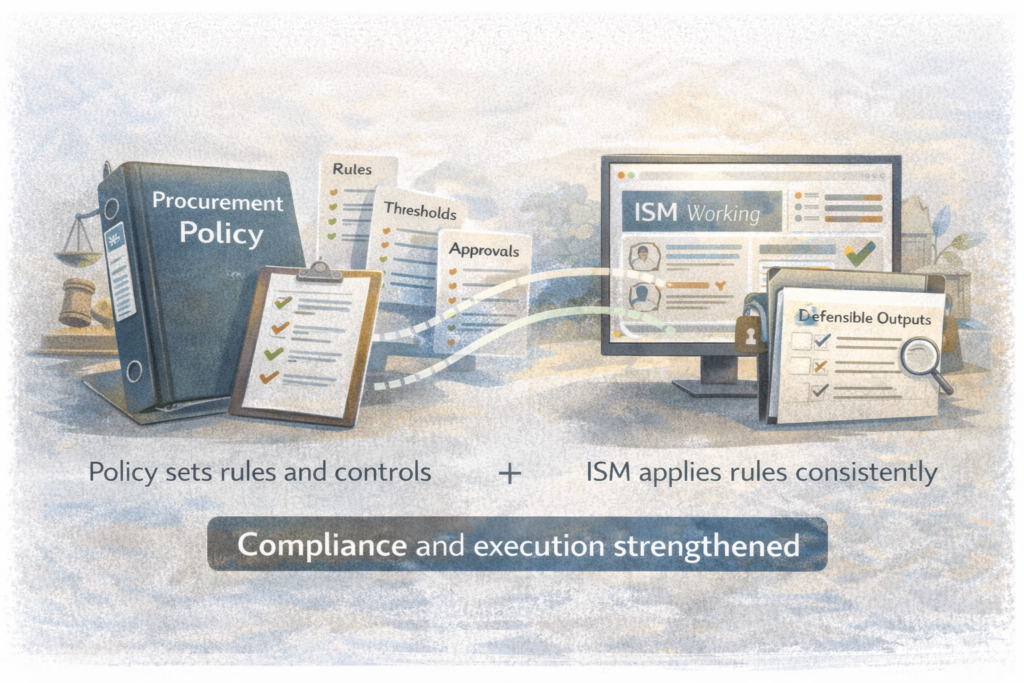
Procurement policy sets the rules — ISM runs the process
Your procurement policy defines the principles, thresholds, and controls your organisation must follow.
ISM does not change those rules.
What it does is turn them into a structured, repeatable process that works in practice. Rather than policy being interpreted differently each time, ISM applies the same logic consistently — across teams, categories, and over time.
Policy sets the what and why.
ISM handles the how.
ISM applies policy — it doesn’t reinterpret it
Most procurement policies already require:
- fair and equal treatment of suppliers
- transparent evaluation criteria
- documented decisions
- a clear audit trail
ISM doesn’t introduce new standards. It enforces the ones you already have.
By removing informal discretion and side communication, ISM reduces compliance, reputational, and challenge risk — without adding extra layers of approval or slowing decisions.
That’s policy applied properly.
Supplier selection criteria still come from you
ISM does not decide what matters.
Your organisation defines:
- requirements
- evaluation criteria
- commercial priorities
ISM ensures those criteria are applied consistently and comparably. It prevents side conversations and informal influence from shaping outcomes.
The system supports evaluation.
It never chooses suppliers on your behalf.
Decision-making authority stays exactly where your policy says it should.
Fairness and transparency are built in
Many policies rely on people remembering to be fair and transparent.
ISM removes that dependency.
The process is structured so that:
- all suppliers receive the same information
- clarifications are shared equally
- timelines are applied consistently
This reduces bias risk and post-decision challenges — without introducing bureaucracy.
Documentation and auditability come as standard
Traditional procurement often leaves evidence scattered across inboxes, spreadsheets, and meeting notes.
ISM avoids this.
It produces clear, structured outputs that support:
- internal approvals
- governance and committee reviews
- audits and assurance
The evidence exists because the process is designed that way — not because someone remembered to document it.
Thresholds, delegations, and approvals still apply
Using ISM does not bypass governance.
Your existing rules around:
- approval thresholds
- delegated authority
- internal sign-off
remain fully intact.
ISM supports these controls by making the process visible and consistent — not by overriding them.
Designed for non-procurement professionals
Many procurement policies assume a level of expertise that doesn’t always exist.
ISM bridges that gap.
It allows non-procurement professionals to run compliant, defensible supplier selection processes without needing to become procurement experts — while still operating fully within policy.
What changes — and what doesn’t
What changes:
- execution becomes consistent
- risk is reduced
- decisions are easier to defend
What doesn’t:
- your procurement policy
- who makes decisions
- where accountability sits
ISM modernises execution without rewriting the rules.
The bottom line
Procurement policy sets direction.
ISM provides disciplined execution.
By applying policy consistently and removing informal discretion, ISM reduces risk while making compliant procurement easier — not harder.
The strongest procurement policies are the ones that are easy to follow.
ISM exists to make that happen.
Thinking about replacing a supplier?
Proco guides you through a structured selection process — defensible, not just instinctive. The deposit is fully refundable.
See how Proco works