
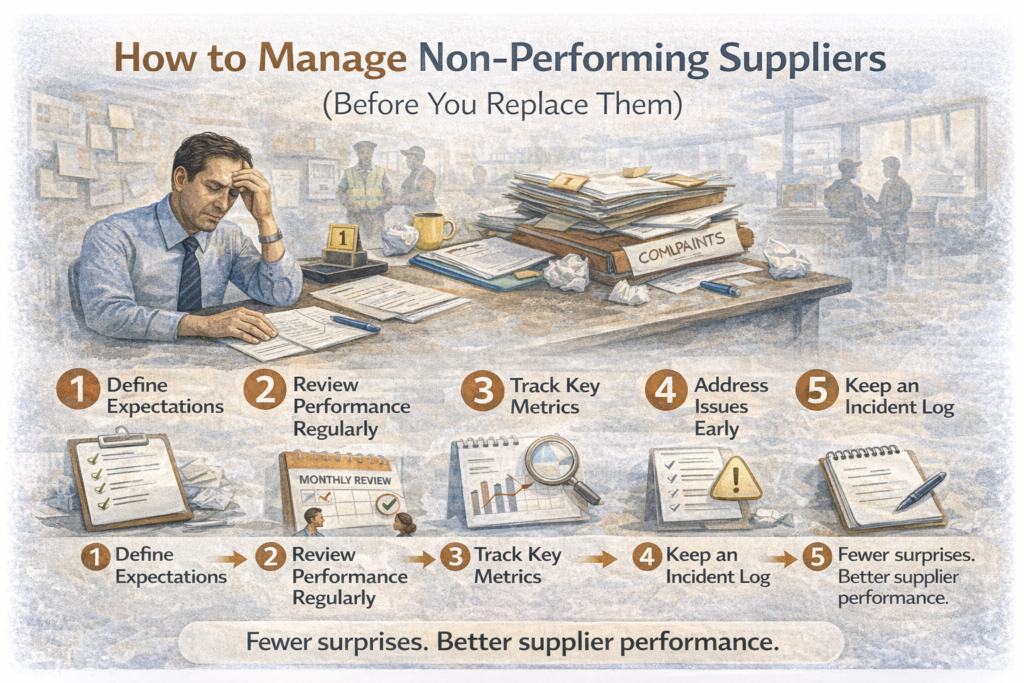
How to Manage Non-Performing Suppliers (Before You Replace Them)

The Familiar Cycle of Replacing Suppliers
If you’re a facilities manager, you’ve probably experienced this before.
A supplier starts slipping. The cleaning standards drop, security response times get slower, or the landscaping suddenly doesn’t look the way it should. Complaints start coming in, frustration builds, and the obvious conclusion is simple: we need a new supplier.
So the supplier gets replaced.
For a while, things improve. But a few months later, the same issues begin creeping back in — just with a different company.
This is a surprisingly common pattern, and it often leads to a difficult realisation: the problem wasn’t only the supplier.
In many cases, the real issue is how the supplier relationship is being managed.
Outsourcing Execution Does Not Mean Outsourcing Responsibility
There’s a common misconception that outsourcing a service means outsourcing the responsibility to manage it.
In reality, you’re only outsourcing the execution, not the accountability.
Many organisations assume that if a supplier looks strong on paper, the service will run itself. But suppliers are no different from employees. Even capable people need clear expectations, feedback, and accountability to perform consistently.
Without structure and oversight, even a good supplier will eventually underperform.
Why Supplier Performance Often Declines
Most supplier problems don’t start with incompetence. They start with unclear expectations and weak oversight.
In many environments:
- Suppliers are given a contract but no clear definition of what success looks like.
- Performance is only discussed when complaints arise.
- There are no measurable KPIs.
- Small problems go unaddressed until they become major frustrations.
This creates a reactive cycle where suppliers drift away from the expected standards and facilities managers end up spending more time dealing with complaints than improving operations.
The result is frustration for everyone involved.
What Good Supplier Management Actually Looks Like
Managing suppliers doesn’t need to be complicated, but it does require consistency. In practice, good supplier management usually comes down to a few simple habits.
1. Define What “Good” Looks Like
Suppliers cannot meet expectations that haven’t been clearly communicated.
Start by defining basic service standards such as:
- Response times
- Frequency of work
- Reporting expectations
- Quality benchmarks
When expectations are clear, performance becomes much easier to assess.
2. Review Performance Regularly
Many supplier relationships only receive attention when something goes wrong. By then, frustration has already built up.
Instead, schedule short, regular check-ins. Even a simple monthly review can help ensure expectations remain aligned and small issues are addressed before they grow.
These conversations often solve problems before they escalate.
3. Track a Few Simple Performance Metrics
You don’t need complex dashboards to manage suppliers effectively.
A few simple indicators can go a long way, such as:
- Response times
- Completion of scheduled tasks
- Inspection scores
- Number of recurring issues
Once performance is visible, conversations with suppliers become objective rather than emotional.
4. Address Problems Early
Small issues rarely stay small if they are ignored.
If a service standard slips, raising it early gives the supplier the opportunity to correct course before performance deteriorates further.
Early intervention protects the working relationship and keeps service levels stable.
5. Keep a Simple Record of Incidents
A basic log of issues, follow-ups, and resolutions can make a significant difference.
Documenting incidents helps create clarity and accountability. It also ensures that if problems persist, there is a clear history of what has been discussed and attempted.
This protects the facilities manager as much as it improves supplier management.
The Real Goal: Fewer Surprises
Good supplier management isn’t about policing vendors.
It’s about creating clarity, accountability, and a shared understanding of expectations.
When suppliers know what success looks like and performance is reviewed consistently:
- Service quality improves
- Problems are resolved earlier
- Relationships become more professional
- Facilities managers spend less time firefighting
In many cases, the difference between a “bad supplier” and a good one is simply better management.
Before replacing your next supplier, it’s worth asking one question:
Have we actually been managing them properly?
Thinking about replacing a supplier?
Proco guides you through a structured selection process — defensible, not just instinctive. The deposit is fully refundable.
See how Proco works