
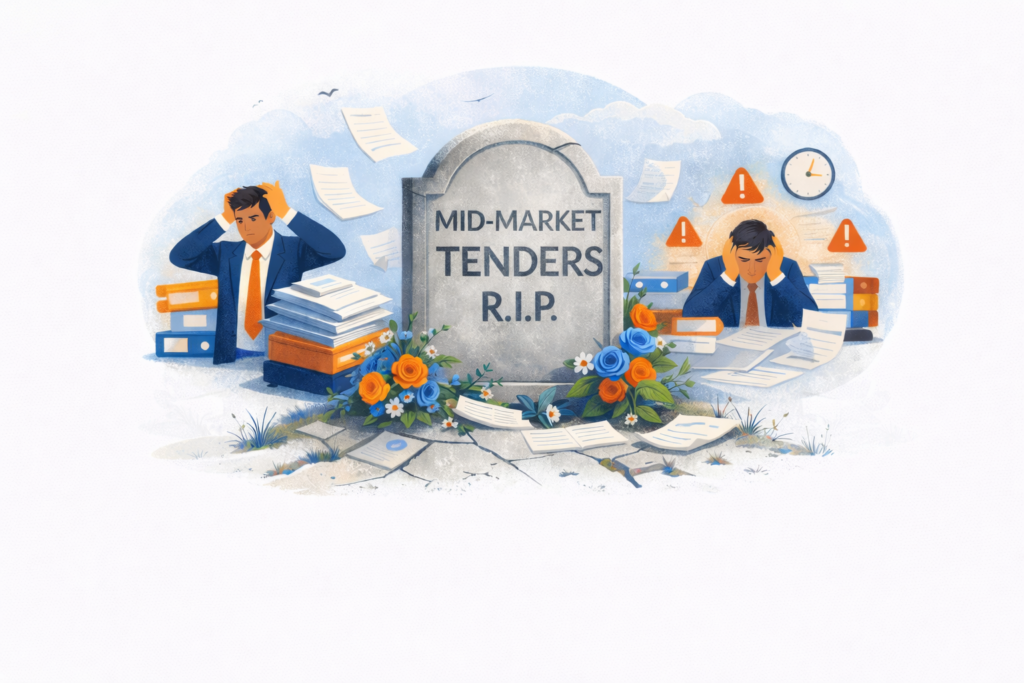
The Death of the Mid-Market Tender

Why traditional tenders fall apart when mid-sized organisations try to run them — and what replaces them.
For years, mid-sized organisations have been told to “run a tender” whenever they need to choose a new supplier. It sounds formal, professional, and thorough — the responsible thing to do.
But here’s the truth:
Tenders weren’t designed for the mid-market.
They were built for large enterprises with procurement teams, templates, systems, and specialist capacity.
So when mid-sized organisations try to run a tender themselves, the process almost always breaks down — not because they are unprofessional, but because the model simply does not fit their reality.
The Real Problem: Tenders don’t Scale Down
The problem is not the tender itself.
Tenders work perfectly well inside corporates.
The problem is what happens when a mid-sized organisation tries to run the same process:
They don’t have the time.
Drafting specs, writing tender packs, reading through proposals — it’s unmanageable alongside daily firefighting.
They don’t have the resources.
There’s no procurement team.
Just an Estates Manager, Operations Manager, or Finance Manager doing their best on the side.
They inevitably cut corners.
Because they must.
No one has 40 spare hours to do a “proper” tender.
They accept inconsistent supplier proposals.
Different formats, different layouts, different information — impossible to compare properly.
They rely on gut feel because the structure isn’t there.
The evaluation becomes subjective, influenced by brand familiarity, relationships, or the most polished document.
They accept supplier-favourable terms and conditions.
Not intentionally — but because writing a fair, balanced contract from scratch is unrealistic.
They call it a tender, but it’s not.
It’s a heavy admin exercise that results in poor supplier choices and no defensible audit trail.
Again — none of this is their fault.
It’s simply the wrong tool for their world.
So What Does the Mid-Market Actually Need?
Mid-sized organisations aren’t looking for a corporate-grade tender.
They’re looking for a credible, confident match — without the bureaucracy.
What they truly need is:
1. A trusted pool of pre-vetted suppliers
Suppliers who are credible, capable, proven, and already operating in the real world — not unverified names pulled from Google.
2. A single source of supplier intelligence
A clear picture of each supplier’s real-world performance, including:
- Capability (what the supplier can deliver operationally)
- Trust Score (how they have performed for other buyers)
- Customer Reviews (direct feedback from organisations like theirs)
This is foundational — it gives them the confidence that they’re speaking to the right suppliers.
3. A focus on the supplier’s solution — not proposal formatting
Once the baseline (capability, trust, and credibility) is already validated,
the focus should shift to the supplier’s actual solution:
- their approach
- their service model
- their improvements
- their design for the buyer’s specific site
This is the part that genuinely matters.
Not who can write the best proposal.
4. A structured, apples-to-apples way to compare suppliers
A process that turns all of this into clear, objective comparisons —
so the buyer can see the strongest fit immediately.
5. A fast, guided journey that keeps workload low
Buyers don’t need complexity. They need a guided path that gets them to a confident decision quickly, without weeks of effort.
Introducing Intelligent Supplier Matchmaking (ISM)
The modern alternative to tenders — built for the mid-market.
ISM gives mid-sized organisations a structured, data-backed way to choose a supplier, without the admin burden of a traditional tender.
It combines five powerful data pillars:
1. Capability Score
A standardised assessment of a supplier’s organisational and operational capability —
completed once, used across all opportunities.
2. Trust Score
Evidence from other evaluators who have assessed the supplier in real pitches and real conditions.
3. Customer Reviews
Straightforward feedback from schools, estates, and facilities teams who have used them.
4. Solution Pitch Score
Your team scores each supplier directly based on how well their pitch aligns with your needs and priorities.
5. Pricing Comparison
Structured, clear, like-for-like pricing — no more guessing what’s included.
Together, these build a balanced match recommendation, weighted to what matters most to you.
And the entire journey takes 40–50 minutes of work from your side, not months.
Why ISM Strengthens Procurement – Without the Overhead
ISM isn’t anti-procurement.
It is procurement done intelligently.
It preserves the fundamentals:
- fairness
- transparency
- competitive tension
- objective comparisons
- defensibility
But eliminates:
- tender packs
- proposal formatting chaos
- spec writing
- scoring spreadsheets
- supplier-led narratives
- subjective decisions
And it ensures you avoid supplier-favourable terms — every time.
Why ISM Fits the Mid-Market Perfectly
Mid-sized organisations need:
- speed
- clarity
- confidence
- evidence
- low admin
- a fair contract
ISM delivers all of this in one journey.
You tell us what matters.
We guide the process.
You compare suppliers easily.
You choose with confidence.
And Proco handles the contracting.
This is the sourcing model the mid-market has always needed —
they just never had access to it.
The Reality: The Tender isn’t Dying – Its Evolving
The tender isn’t dead because it failed.
It’s dead in the mid-market because the mid-market was never designed to run it.
Intelligent Supplier Matchmaking is the evolution:
leaner, smarter, faster, and built for real-world constraints.
This is the future of supplier selection.
This is ISM.
This is Proco.
Thinking about replacing a supplier?
Proco guides you through a structured selection process — defensible, not just instinctive. The deposit is fully refundable.
See how Proco works