
5 Myths About Switching Suppliers That Keep Organisations Stuck

A clear-eyed look at what really happens when you stick with — or switch — a supplier
Most mid-sized organisations don’t switch suppliers often. Not because their supplier is performing well, but because switching simply feels risky. And when teams are overloaded and juggling daily operations, perceived risk is often more powerful than actual risk.
But over the years, you start to see the patterns.
The same assumptions come up again and again — and they quietly keep organisations stuck in relationships that aren’t serving them anymore.
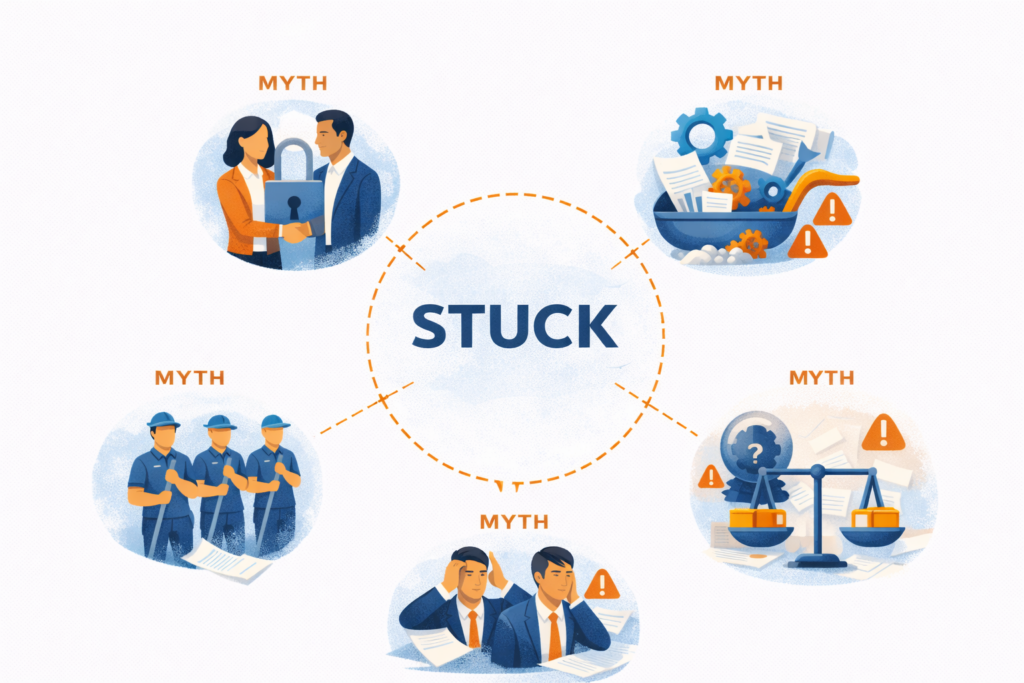
Here are the five biggest myths that hold teams back, and what really sits behind them.
Myth 1: “It’s easier to stay with the supplier we know.”
This is probably the most common belief, and to be fair, it makes sense.
When life is busy and your day is spent keeping things running, the last thing you want is more disruption. Familiarity feels safe — even when the service isn’t particularly good.
But stability and comfort are not the same thing.
What usually happens is a slow drift: small issues appear, then become routine, then stop being raised. Standards slip quietly. Your team compensates without even realising it. Over time, you end up absorbing work that the supplier should be doing.
Staying “because it’s easier” is often the most expensive decision you can make — operationally, financially, and mentally.
Myth 2: “Switching suppliers will create more work for us.”
This belief comes from a very specific place:
the tender process.
People assume that switching means running a tender.
And if that were true, switching probably would be harder.
But switching itself is not the problem.
It’s the admin-heavy, formal, document-driven process people associate with switching.
The truth?
A well-prepared supplier can transition smoothly when expectations are clear and the service is properly understood. The heavy work is not the switch — it’s the poor structure that usually precedes it.
In fact, staying with a low-performing supplier creates far more ongoing work than switching to a strong one ever will.
Myth 3: “A new supplier won’t understand our site as well as our current one.”
This one is emotionally true — but operationally misleading.
Yes, the incumbent has been around.
Yes, they know the layout, the quirks, the staff, the rhythm of the place.
But site familiarity does not equal high performance.
If anything, it’s often the root of complacency. Suppliers who have “always been here” tend to stop looking for efficiencies, stop improving, and stop challenging themselves. That familiarity becomes a comfort blanket, not a capability signal.
Strong suppliers learn fast.
Weak suppliers hide behind familiarity.
A fresh supplier with clarity, good supervision and proper onboarding will outperform an underperforming incumbent every time.
Myth 4: “All suppliers are basically the same.”
On the surface, cleaning suppliers all look similar.
Uniforms, mops, machines, chemicals — it’s easy to assume that switching won’t make much difference.
But beneath the surface, the differences are enormous.
Some suppliers manage continuity well.
Some rotate staff constantly.
Some supervise daily.
Some barely supervise at all.
Some communicate clearly.
Others only respond when chased.
Some prevent disruption; others create it.
The outcome you experience — the daily quality, the consistency, the burden on your team — comes from the invisible parts of the operation. And that’s where suppliers vary the most.
The assumption that “everyone is the same” keeps organisations locked into years of unnecessary friction.
Myth 5: “Switching is risky — what if the new supplier is worse?”
This fear is understandable.
Many organisations have switched suppliers before and had a bad experience, or heard stories of transitions gone wrong.
But here’s the truth:
Switching without structure is risky.
Switching with structure is not.
If you switch based on:
- relationships
- fast responses
- three quotes that aren’t comparable
- gut feel
- or a sense of urgency
…then yes, the risk is high.
But when you switch based on:
- capability evidence
- past performance
- customer reviews
- structured comparison
- and clear requirements
…the risk drops dramatically.
The danger isn’t switching — it’s switching blindly.
The real question isn’t “Should we switch?”
It’s: “Is our current supplier still giving us the service we need?”
If the answer is uncertain, switching isn’t a risk — it’s an opportunity.
But you need clarity before you decide.
Not sure whether it’s time to switch?
Start with our quick 2-minute Supplier Review Check.
It shows whether your supplier is supporting you — or quietly holding you back.
Thinking about replacing a supplier?
Proco guides you through a structured selection process — defensible, not just instinctive. The deposit is fully refundable.
See how Proco works