
How to Evaluate Suppliers: A Practical Supplier Evaluation Framework for Mid-Sized Organisations

Most organisations don’t struggle to find suppliers — they struggle with how to evaluate suppliers properly.
Without clear supplier evaluation criteria, decisions are often driven by price, familiarity, or gut feel rather than evidence. This guide introduces a practical supplier evaluation framework designed for mid-sized organisations that need to choose suppliers with confidence.
Why supplier evaluation often goes wrong
When organisations try to assess suppliers informally, a few common patterns emerge:
- Price is compared before capability is understood
- Proposals are impressive, but vague
- Oversight and accountability are assumed, not tested
- Past relationships are mistaken for future reliability
The result is often a supplier that looks good on paper, but struggles in practice.
What’s missing isn’t effort — it’s structure.
A practical supplier evaluation framework: the supplier evaluation criteria that matter
This supplier evaluation framework breaks supplier evaluation criteria into clear, practical steps that make it easier to understand how to evaluate suppliers without running a formal tender.
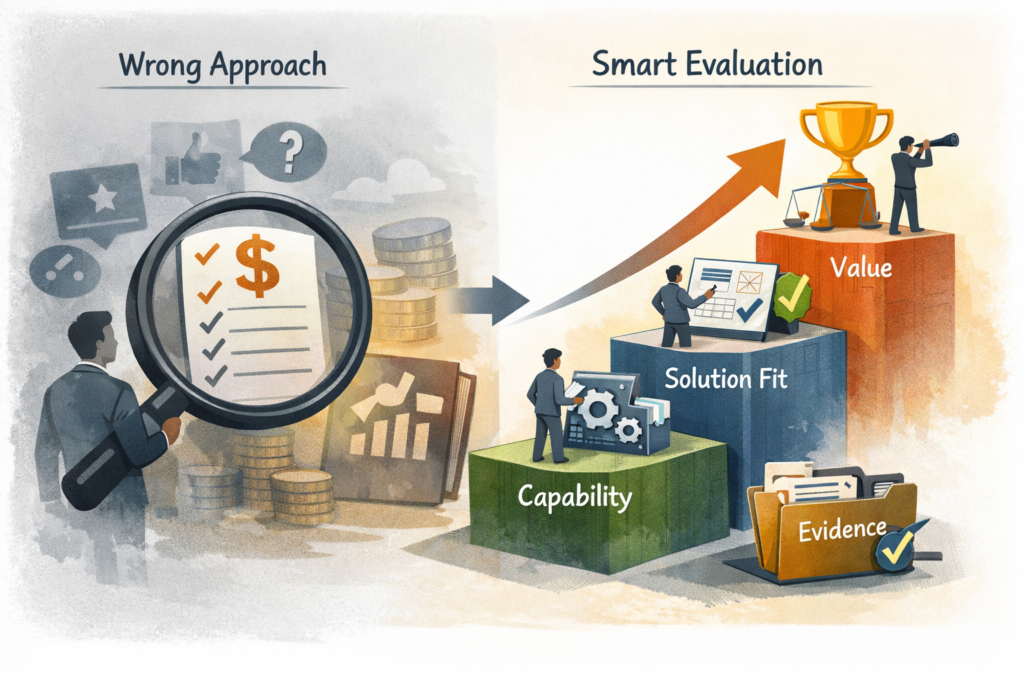
To evaluate suppliers properly, it helps to separate the decision into two distinct layers:
- Organisational capability – is this a strong supplier at all?
- Solution fit – is what they’re proposing right for your needs?
Pricing then becomes an overlay — not the starting point.
1. Organisational Capability
Is this supplier fundamentally capable of delivering the service?
Before considering proposals or pricing, it’s critical to understand whether the supplier is a well-run organisation.
Key capability criteria include:
- Expertise
Do they have the technical and operational know-how required for the service? - Experience
Have they delivered similar services in similar environments before? - Reliability
Can they perform consistently over time, not just at contract start? - Customer service structure
How are issues handled, escalated, and resolved day to day?
This level of evaluation helps avoid suppliers who look convincing in presentations but lack operational depth. Organisational capability is the foundation of any strong set of supplier evaluation criteria.
2. Solution Fit
Does the proposed solution actually match your requirements?
Once organisational capability is established, attention should shift to the supplier’s proposed solution.
Here, the focus is on practical fit:
- Does the service model align with your needs?
- Is the solution adapted to your site and operating environment?
- Who is accountable for performance on this specific contract?
- How clearly does the supplier explain how the service will run?
This step is best assessed through structured supplier presentations rather than informal conversations. At this stage of the supplier evaluation framework, pricing should assessed only after capability and solution fit are understood.
3. Commercial Clarity
Is the price fair for the level of capability and service offered?
Pricing only becomes meaningful once capability and solution fit are understood.
Instead of asking “Who is cheapest?”, the better question is:
“Who offers the best value for the level of capability delivered?”
Effective pricing evaluation looks at:
- Transparency of cost components
- Comparability between suppliers
- Alignment between price and service quality
The lowest-priced supplier is not automatically the best value — but a capable, reliable supplier at a competitive price often is.
4. Evidence
What proof exists beyond the sales pitch?
Evidence strengthens every stage of supplier evaluation.
This can include:
- References from similar organisations
- Feedback from other customers
- Performance indicators from previous engagements
Evidence helps confirm whether suppliers can do what they claim — not just describe it well.
Common supplier evaluation mistakes
Even experienced teams make these errors:
- Prioritising price too early
- Confusing confidence with capability
- Assuming oversight will “sort itself out”
- Treating supplier selection as a one-off task
These shortcuts often lead to service issues, hidden costs, and the need to revisit the decision sooner than expected.
The takeaway
Good supplier evaluation doesn’t require a formal tender or specialist training.
It requires:
- assessing organisational capability first
- evaluating solution fit second
- viewing price in context
- and validating decisions with evidence
This structured approach consistently leads to better supplier outcomes — with less risk and less disruption. When organisations apply clear supplier evaluation criteria within a structured supplier evaluation framework, it becomes far easier to understand how to evaluate suppliers effectively and consistently.
Not sure where your current supplier stands?
If you’re uncertain whether your existing supplier still meets these criteria, a quick review can help.
👉 Take the 60-second Supplier Review Health Check
It provides a simple signal on whether things are working — or whether it’s time to look closer.
A final note
For organisations that don’t run procurement processes often, building and applying this evaluation framework from scratch can be time-consuming.
Defining criteria, applying them consistently, gathering evidence, and comparing suppliers properly all take effort — even when the approach itself is straightforward.
Proco’s Intelligent Supplier Matchmaking applies this exact framework in a guided way, using a ready-built supplier intelligence base to remove admin without removing rigour.
Thinking about replacing a supplier?
Proco guides you through a structured selection process — defensible, not just instinctive. The deposit is fully refundable.
See how Proco works