
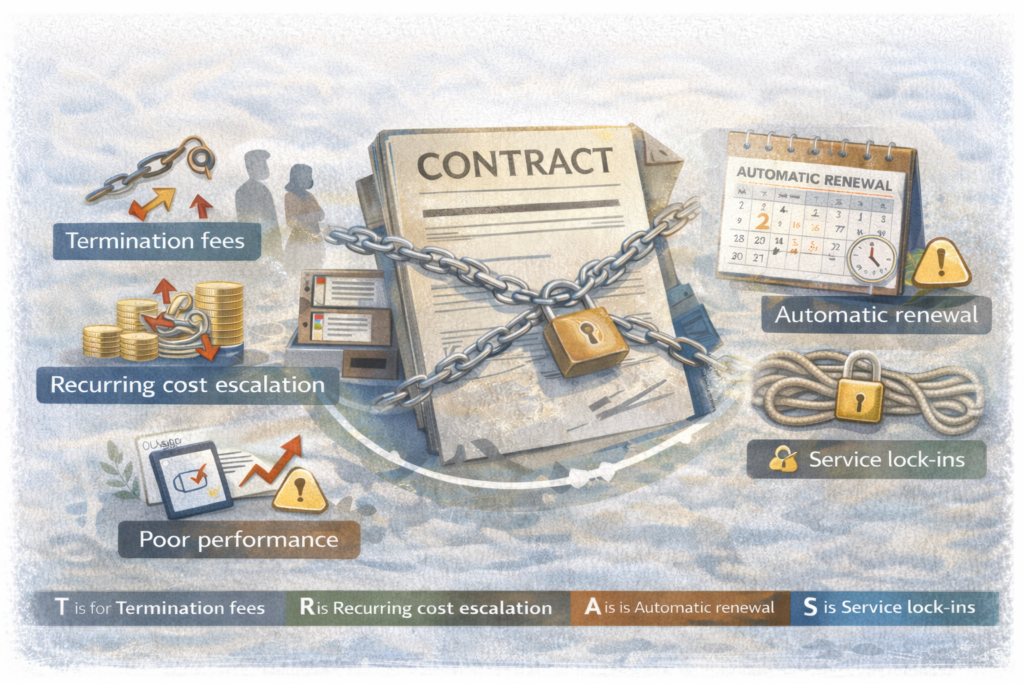
The Contract T.R.A.P.S Organisations Keep Falling Into — and How to Avoid Them

Year one looks good.
You save money.
Everyone’s satisfied.
Year two arrives — and suddenly the contract costs more than before.
Not because the service improved.
Because the contract did exactly what it was designed to do.
This shows up everywhere — security, cleaning, IT, catering, maintenance. The service stays the same, but the cost quietly creeps up. Not through carelessness, but because contracts are often accepted at face value, without pressure-testing what really happens over time.
Let’s look at the Contract T.R.A.P.S organisations keep stepping into — and how to sidestep them.
T is for Termination fees
The trap:
Large penalties for exiting a contract early.
On paper, the deal looks competitive. In reality, you’re locked in. If performance drops or your needs change, walking away becomes painfully expensive.
We’ve seen organisations pay significant sums just to exit underperforming contracts.
How to avoid it:
- Remove termination fees altogether, or
- Replace them with reasonable notice periods
Suppliers still get certainty. You retain control.
R is for Recurring cost escalation
The trap:
Automatic annual price increases baked into the contract — often 10% or more.
It doesn’t feel dramatic in year one. But compounded over several years, that “standard clause” quietly erodes any initial saving. What looked competitive becomes expensive without anyone actively agreeing to it.
How to avoid it:
- Cap increases to CPI, or
- Link them to a recognised cost index
If prices go up, there should be a clear, defensible reason.
A is for Automatic renewal
The trap:
The contract renews itself without you explicitly approving it.
Many organisations only realise this after renewal has already kicked in — sometimes for another full year or term. At that point, leverage is gone.
How to avoid it:
- Require manual renewal
- Force an active decision point
Good suppliers will still be renewed.
They just won’t be renewed by accident.
P is for Performance (or the lack of it)
The trap:
Once the contract is signed, performance stops being measured.
Most organisations track finances closely, but supplier performance often runs on trust. Poor service is tolerated not because it’s acceptable, but because it’s hard to prove.
How to avoid it:
- Build in a simple SLA
- Use a small number of clear, measurable KPIs
Performance shouldn’t be subjective.
It should be visible.
S is for Service lock-ins
The trap:
You’re prevented from scaling services down — even when demand drops.
This shows up as paying for capacity you no longer use, services that have outgrown their purpose, or volumes that made sense years ago but not today.
How to avoid it:
- Include flexibility clauses
- Allow scope and volume adjustments over time
Your organisation changes.
Your contracts should be able to change with it.
This isn’t about “bad suppliers”
Suppliers aren’t villains for protecting their commercial interests.
That’s business.
Most suppliers assume their terms are accepted unless challenged — because, in many cases, they are. The problem isn’t intent; it’s imbalance.
Long-term contracts aren’t consumer purchases. There’s no fallback protection once the contract is signed. The contract is the protection.
Where the leverage actually sits
Here’s the part that’s often missed.
The leverage to avoid these traps exists before suppliers are selected — not once contracts are already signed and lawyers are involved.
Arguing clauses after the fact rarely works. Structuring expectations upfront does.
That’s where Intelligent Supplier Matchmaking (ISM) comes in.
ISM is a mechanism that allows organisations to:
- define their terms upfront
- compare suppliers on a like-for-like basis
- surface hidden clauses early
- select suppliers aligned on both service and contract expectations
It shifts control to the point where it actually matters.
A quick sense check
Before you move on, ask yourself:
- Can you exit your main contracts without penalty?
- Do prices increase automatically each year?
- Do contracts renew without an active decision?
If any of those answers are “yes”, you’re likely carrying more risk than you think.
The bottom line
If you want better contracts, stop accepting what’s offered — and start setting the rules.
Contracts shouldn’t surprise you in year two.
And cost control shouldn’t rely on luck.
Intelligent Supplier Matchmaking exists to make that shift deliberate — not accidental.
Thinking about replacing a supplier?
Proco guides you through a structured selection process — defensible, not just instinctive. The deposit is fully refundable.
See how Proco works